

Step-by-Step Drifting Guide for Beginners in CPM2
Drifting in Car Parking Multiplayer 2 (CPM2) requires the right car setup, balanced tuning, and precise control of the throttle, steering, and handbrake. High horsepower is not essential for beginners. A well-tuned rear-wheel-drive (RWD) car with suitable tires and alignment can drift effectively with much less power.
Choosing the Best Beginner Drift Car
Several RWD cars in CPM2 are suitable for learning how to drift:
- Nissan 180SX
- Toyota Chaser
- Toyota Mark II
- Nissan GT-R R32 with an RWD swap
- Nissan GT-R R33 with an RWD swap
- Kia Stinger
- Nissan S13
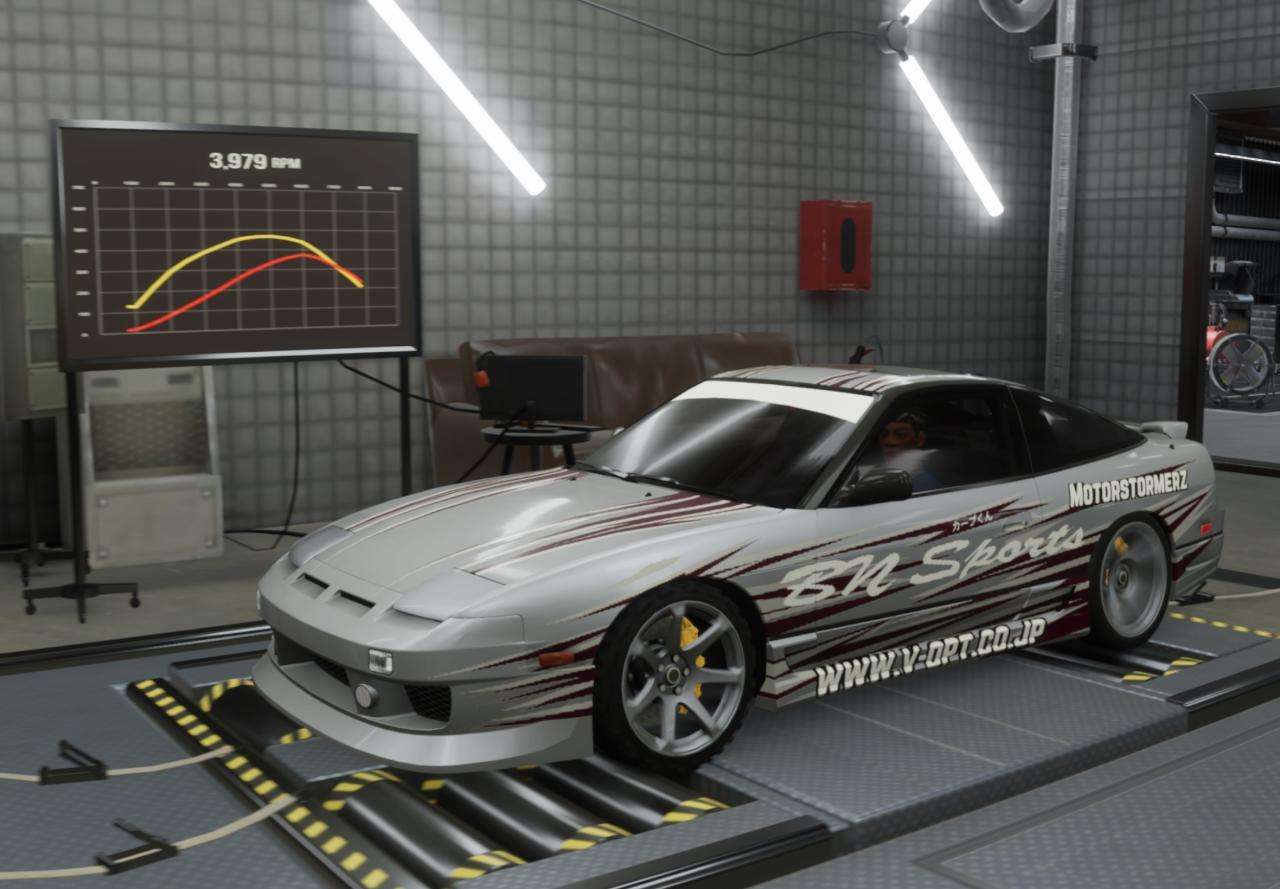
The Nissan 180SX is the recommended starting point because it is affordable, can be purchased with in-game cash rather than coins, and is relatively easy to tune and control. The Nissan 240SX is also mentioned as a suitable option.
This guide uses the Nissan 180SX as its main example.
Engine Tuning and Tire Setup
A car does not need more than 1,000 horsepower to drift. The key is balancing engine power, alignment, and tire setup.
Recommended Horsepower
Use the following power ranges as a starting point:
- 300 to 400 HP: Suitable for beginners learning the basics.
- 500 to 700 HP: Provides more power for smoother drifts once basic control improves.
- 800 HP and above: Difficult to control and more likely to cause spin-outs if the tune is not well balanced.
A 400 HP car is sufficient for learning how to initiate and maintain a drift.
Front and Rear Tire Width
Tire width affects how easily the rear of the car breaks traction and how much control is available during a slide.
Thin rear tires: 155 to 180 mm
- Easier to slide.
- Work well with lower-powered cars producing around 300 to 400 HP.
- Suitable for beginners learning drift control.
Wider rear tires: 185 to 250 mm
- Provide more grip, making the car harder to slide.
- Require more frequent handbrake use to initiate drifts.
- Offer better control at higher speeds.
The rear tires should not be so wide that initiating a drift becomes difficult, but making them excessively thin can also make the car uncontrollable. Finding a balance between grip and wheelspin is essential.
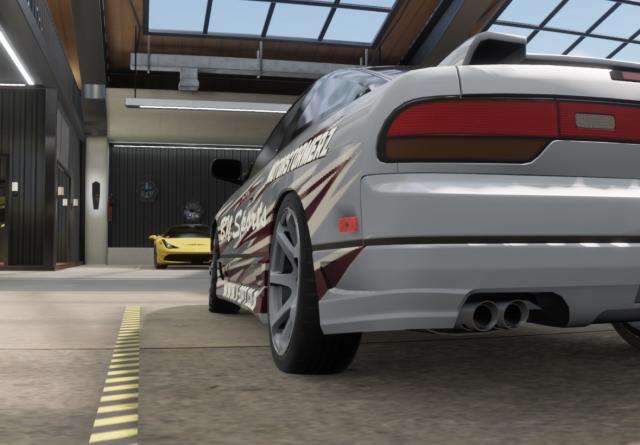
One example setup uses 205 mm rear tires and 175 mm front tires.
Tire Types and Pressure
The recommended tire combination is:
- Front: Off-road tires for more consistent steering grip.
- Rear: Touring tires to make the rear end easier to manage during a drift.
Off-road tires provide more predictable front-end grip than touring tires, particularly when running low tire pressures.
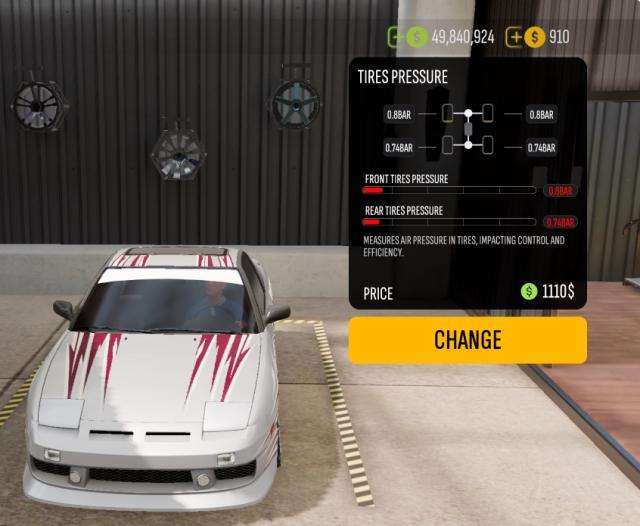
Recommended pressure ranges:
| Tire position | Tire type | Pressure |
|---|---|---|
| Front | Off-road | 0.6 to 1.1 bar |
| Rear | Touring | 0.5 to 0.9 bar |
Adjust tire width and pressure together until the car can initiate a slide without becoming excessively unstable.
Suspension and Alignment
Suspension stiffness and softness largely come down to personal preference. Alignment has a more direct effect on steering response and drift control.
Steering Angle
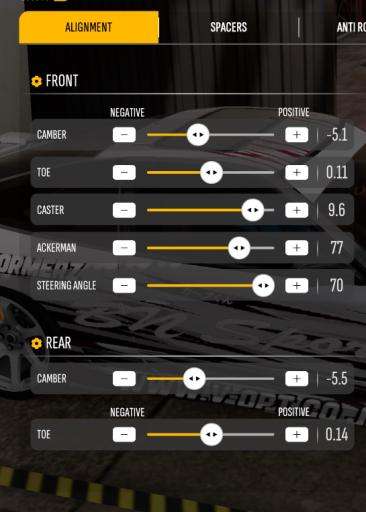
Set the steering angle to its maximum value, ideally between 65° and 70°.
Most cars can reach approximately 70°, although some are limited to 50°. Drifting with a 50° steering angle is more difficult and requires additional techniques to compensate for the reduced steering range.
Ackerman Angle
The Ackerman angle affects how the front wheels turn relative to each other. With Ackerman steering, the inner wheel turns through a greater angle than the outer wheel, helping the wheels follow different arcs through a corner and reducing tire scrubbing.
The main effects are:
- Higher Ackerman: Sharper, more direct steering.
- Lower Ackerman: Smoother but less reactive steering.
A range of 50% to 70% is a useful starting point in CPM2. Adjust it according to how naturally the car responds to steering inputs.
Caster
Caster affects stability and steering sensitivity.
Higher positive caster:
- Makes the car feel more stable.
- Produces a slower steering response.
- Makes the car less twitchy when turning.
Lower caster:
- Makes the car more sensitive to steering inputs.
- Produces quicker turns and more pronounced flicks into corners.
- Can make the car difficult to control when set too low.
Choose a caster setting that provides enough stability without making the car too slow to react.
Toe Angle
Toe angle influences how reactive the car feels during a turn.
- More toe-in: Produces more understeer, making the car less reactive and more stable.
- Less toe-in: Produces more oversteer, making the car more reactive but increasing the risk of spinning out.
Use toe angle to fine-tune the car’s behavior after setting the steering angle and Ackerman.
How to Initiate and Maintain a Drift
The most beginner-friendly initiation method combines high engine RPM with a handbrake tap.
Starting a Drift
- Build up some speed before entering the corner.
- Approach the corner while keeping the engine at high RPM.
- Tap the handbrake to break rear traction and swing the rear of the car outward.
- Counter-steer by turning the steering wheel or stick in the opposite direction to catch the slide.
Counter-steering helps prevent the car from rotating too far and allows you to maintain control throughout the drift.
Maintaining the Slide
Once the car is sideways, the goal is to balance throttle, handbrake, and steering rather than holding the accelerator fully down.
- Throttle: Apply and release the accelerator in short inputs to control wheelspin.
- Handbrake: Tap it when the car begins losing drift angle or grip.
- Counter-steering: Adjust the steering smoothly to keep the car balanced.
A 400 HP car can maintain a drift without constant full throttle. Controlled acceleration combined with occasional handbrake taps helps keep the car in a stable slide.
How to Transition Between Drifts
A drift transition occurs when the car switches from sliding in one direction to sliding in the opposite direction. Smooth transitions allow multiple corners to be linked into a continuous run.
Transition Technique
- While drifting, identify the next corner in the opposite direction.
- Turn the steering wheel toward the next corner.
- Tap the handbrake as you turn to initiate the change in direction.
- Immediately counter-steer to catch the car and hold the new slide.
The sequence is weight shift, handbrake, then counter-steer.
Turning toward the next corner first shifts the car’s weight in that direction, helping maintain balance during the transition. Pulling the handbrake and counter-steering without first shifting the car’s weight can cause a spin-out.
Timing and Practice
Transitions happen quickly, so timing is critical.
- Waiting too long can cause the car to spin out.
- Flicking too early can cause you to lose your intended line.
- Start slowly and increase speed as your timing improves.
Wide S-curves are ideal for practicing this technique. Drift Track City 1 is a recommended location for learning transitions.
Recovering From a Spin-Out
One common mistake is maintaining full throttle even when the car begins losing balance.
If the car starts to spin out:
- Release the accelerator.
- Counter-steer to straighten the slide and regain control.
Lifting off the throttle reduces the car’s tendency to continue spinning and gives you an opportunity to catch the slide before it develops into a full spin-out.
Avoid treating full throttle as the solution to every loss of control. Knowing when to release the accelerator is an important part of drifting.
Maintaining Continuous Drifts
Continuous drifting means maintaining balance through successive corners rather than repeatedly initiating isolated slides.
The main controls work together:
- Throttle: Use short accelerator inputs to maintain wheelspin between turns.
- Handbrake: Apply brief taps when the car loses angle or needs the drift reset.
- Counter-steering: Use smooth adjustments to catch the car before it spins out.
The objective is to keep the car balanced while linking one corner to the next. Smooth, controlled inputs are more effective than constantly applying full throttle or repeatedly pulling the handbrake.
Practice on a Roundabout
A roundabout provides a useful environment for practicing continuous drifts. Drive in circles and focus on keeping the car on a consistent line for as long as possible.
The longer you maintain a controlled slide without losing balance, the better you become at managing throttle, steering, and handbrake inputs. This practice develops the control needed to link individual corners into longer drift runs.
Managing Drifts Through Long Corners
Long, wide corners, such as those found on the desert map, require careful control of speed, throttle, braking, and drift angle.
The best recovery method depends on the car’s horsepower and brake strength.
Low-Horsepower Cars With Weak Brakes
For lower-powered cars with weak brakes, avoid relying on the normal brakes in the middle of a drift. They can reduce momentum and make it harder to maintain the slide.
Use the handbrake as the primary mid-drift correction tool.
If the car has too much angle or insufficient speed:
- Tap the handbrake briefly to slow the car slightly.
- Turn the steering wheel away from the corner to straighten the car.
- Regain balance.
- Smoothly initiate the drift again.
The objective is to correct the car’s position without losing control or unnecessarily disrupting its momentum.
High-Horsepower Cars With Strong Brakes
Higher-powered cars react more quickly and can use a combination of the normal brake and handbrake for corrections. When a drift begins to fail because the car is losing angle or sliding too far outward, use the normal brake rather than the handbrake.
- Tap the normal brake.
- Turn the steering wheel into the corner.
- Balance the throttle as the car stabilizes.
- Continue the drift once the car returns to a controllable line.
Turning into the corner helps use the car’s power and grip to bring it back into line.
Tips for Long, High-Speed Drifts
- Make corrections more gradually as speed increases.
- Avoid repeatedly tapping the handbrake. One short input may be enough to save a drift.
- Learn how your specific car and tune behave on wide corners, because different setups react differently.
Consistent throttle control, measured braking, and smooth steering corrections are essential for maintaining long drifts without spinning out or losing the intended line.


Be the first to comment