

Guild League Main Battlefield
Battle Overview
Guild League battles use a 60-player team structure consisting of 12 parties with 5 players each. The team should use defined roles and maintain enough redundancy to remain effective after casualties while simultaneously handling multiple objectives.
The recommended battle flow is divided into four stages:
- 0 to 5 minutes: Establish lane control and vision.
- 5 to 15 minutes: Contest the Floating Island and manage mid-game rotations.
- 15 to 22+ minutes: Use the power spike gained from the second MVP Doppelganger to pressure objectives.
- Late game: Optimize victory-point gains if the enemy Crystal cannot be destroyed immediately.
Recommended Role Distribution
| Role | Players | Primary Responsibilities |
|---|---|---|
| Frontline / Tankers | 12 | Absorb damage, lead tower pushes, and defend objectives |
| Bruisers / Off-tanks | 8 | Apply lane pressure, duel enemies, and split-push |
| Damage Dealers / DPS | 18 | Deal burst and multi-target damage, destroy towers, clear minions, and kill MVPs |
| Siege / Ranged AOE | 8 | Deal tower-focused damage and control zones during MVP fights |
| Support / Healers / Buffers | 8 | Sustain the team, cleanse, and provide buffs during prolonged fights |
| Utility / Scouts / Roamers | 6 | Provide vision, flank, contest portals, and prevent enemy captures |
| Total | 60 |
Party composition should ensure that every party has at least one frontline player, one support or utility player, and a mixture of damage dealers. This allows individual parties to remain viable when operating independently.
Party Assignment
A practical party structure can use several archetypes and repeat them across the 12 parties.
Lane Hold Party
- Tank
- Healer
- Ranged AOE
- DPS
- Scout
Heavy Push Party
- Bruiser
- Siege
- 2 DPS
- Support
Roam / Contest Party
- 2 Roamers
- DPS
- Support
- Tank
The number of Heavy Push and Lane Hold parties can be adjusted between matches according to the enemy composition and available scrim data. Maintaining several different party archetypes provides redundancy and allows parties to switch objectives as needed.
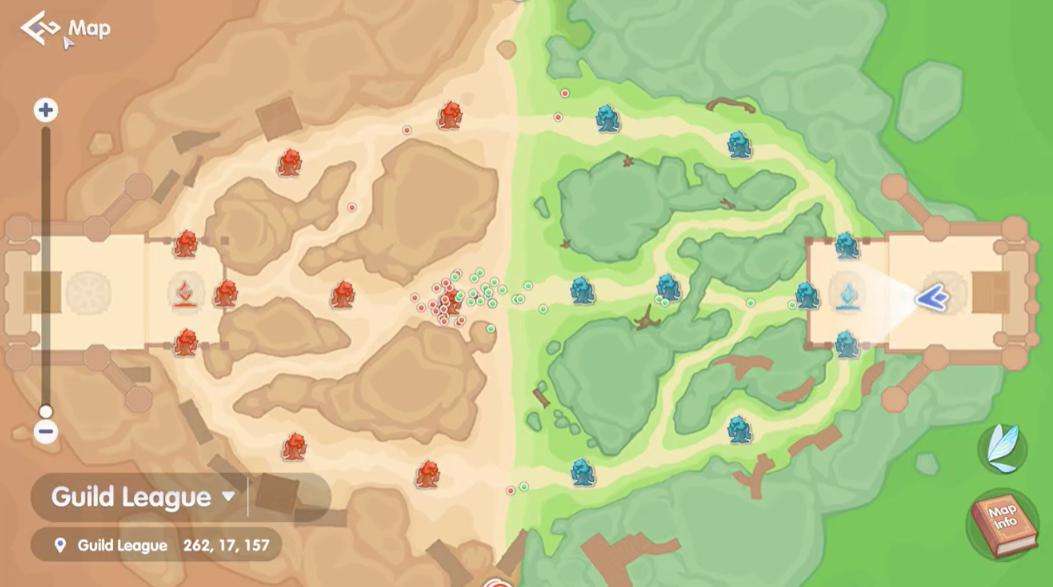
Map and Lane Strategy
Assign four parties to each of the three lanes as a basic structure: top, middle, and bottom.
Each lane should have:
- 3 lane-holding parties
- 1 rapid-rotation party capable of moving to the Floating Island
This creates a static allocation of 20 players per lane while preserving a dedicated rotation plan.
Static Lane Responsibilities
Outer towers: Assign two defensive parties to each lane. Siege players from the quick-rotation party should reinforce these groups when a push begins.
Middle and high-ground towers: Heavy Push parties should prioritize these towers during periods when the Floating Island is not being contested, specifically outside the one-minute window before and after MVP Doppelganger spawns.
Pressure balance: Do not move all 12 parties into a single lane during the early game. Keep at least one party per lane to maintain vision and accumulate points.
If the enemy commits heavily to one lane, use a counter-rotation within approximately two minutes. Send one or two parties to punish the enemy’s overcommitment while maintaining enough players to defend the other lanes.
Floating Island Contest
The Floating Island is a critical objective at approximately 5 and 15 minutes.
Staging and Rotation
At approximately 4:00, begin preparing for the Floating Island contest:
- Two dedicated Rotation Parties, one from the top lane and one from the bottom lane, move toward their respective portals.
- An additional Roamer squad positions itself in the middle lane to provide a quick contest option.
- At approximately 4:30, Siege/AOE and DPS players join the rotation.
- Healers and tanks arrive later so they can absorb damage once the main engagement begins.
- Use precise countdown callouts at 60 seconds, 30 seconds, and 10 seconds before the objective.
The same approach can be applied to the second Floating Island contest around the 15-minute mark.
MVP Damage Assignment
Designate a MVP Damage Lead, consisting of one top DPS player and one backup. Their primary responsibility is maximizing damage dealt to the MVP to secure the team buff.
During the fight:
- MVP Damage Lead: Focuses on maximizing damage against the MVP.
- Support: Maintains sustained healing and buffs on the team.
- Siege / Ranged AOE: Controls the area and deals with additional enemies.
- Scouts: Track enemy flankers and interrupt opposing damage dealers.
- Tanks: Arrive with the main engagement force and absorb incoming damage.
If the enemy contests the objective with a large force, commit to the fight only when the team has a realistic chance of securing the highest damage during the spawn window. If that cannot be achieved, disengage and preserve players while taking advantage of resources and objectives elsewhere on the map.
Poring Tip: Landing the final hit on a Doppelganger counts as an additional 5% damage.
After Securing the MVP
The team that deals the most damage receives a team buff and resources. Use this advantage immediately rather than allowing the power spike to expire without converting it into an objective.
Within the next 1 to 2 minutes:
- Force a tower take, or
- Establish vision and look for pick-offs.
Assign two Heavy Push parties to convert the MVP advantage into an objective.
Rotation and Communication
Major rotations should be fast and coordinated to avoid leaving lanes undefended.
Standard Callouts
Use short, consistent commands such as:
Portal top in 60/30/10MVP engagePush X towerDefend crystalRotation now
Voice communication can be organized through Discord with separate channels for each lane and a command channel. Use in-game pings for players who are not participating in voice communication.
Rotation Timing
Limit major rotations to approximately 20 to 30 seconds whenever possible.
Use staggered departures:
- First movers clear the lane and prepare the route.
- The main force warps in approximately 10 seconds later.
This reduces the amount of time that a lane remains exposed.
Emergency Recall
A full recall should be triggered when:
- A lane has lost fewer than 3 towers and requires immediate reinforcement, or
- The enemy is pushing the Crystal.
The two nearest parties should respond immediately.
Keep 6 players, consisting of Utility and DPS members, assigned to a dedicated Crystal defense rotation. Their purpose is to prevent sudden enemy victories while the rest of the team is occupied elsewhere.
Mid- and Late-Game Priorities
When the MVP Buff Is Secured
Immediately prioritize:
- The high-ground tower.
- The nearest middle tower.
The team with the MVP buff should actively force fights while the buff is available, using the temporary advantage to secure objectives.
When the MVP Buff Is Denied
Shift the focus toward victory-point objectives, particularly:
- Player kills
- Map control
- Isolated enemy targets
- Buildings and towers
Specialized Squads
A coordinated team can divide its players into specialized groups during the mid and late game.
Kill Farming Squad
12 players
Roam primarily through the middle of the map and look for isolated enemies. Their objectives are to secure kills and destroy buildings.
Point-Hold Squad
18 players
Occupy forward control zones, maintain map presence, and defend towers.
Reserve Response Squad
10 players
Remain mobile and respond to enemy rotations. Their primary tasks are stopping enemy roaming groups and reinforcing threatened towers or the Crystal.
Late-Game Crystal Push
If the enemy becomes vulnerable to a split push, such as while its main force is fighting on the Floating Island or after the enemy team has been wiped, commit to a coordinated Crystal strike.
Send 2 parties, or 10 players, toward the enemy Crystal while the remaining players continue applying pressure elsewhere.
Use stealth or Hide to conceal the approach when possible. The objective is to prevent the enemy from recognizing the Crystal push early enough to regroup and defend.



Be the first to comment