

Optimal Attribute Builds for Physical and Magic Damage
This guide covers all nine race and class combinations in Dimraeth Early Access, with optimized attribute distributions for maximizing physical or magic Combat Power. Each build specializes in one damage type rather than combining physical and magic investments.
The recommendations account for starting attributes, racial and class passives, attribute upgrade costs, and the level 25 cap. The builds maximize additive Combat Power, excluding equipment, runes, and skill-tree bonuses.
How Attribute Scaling Works
Combat Power formulas
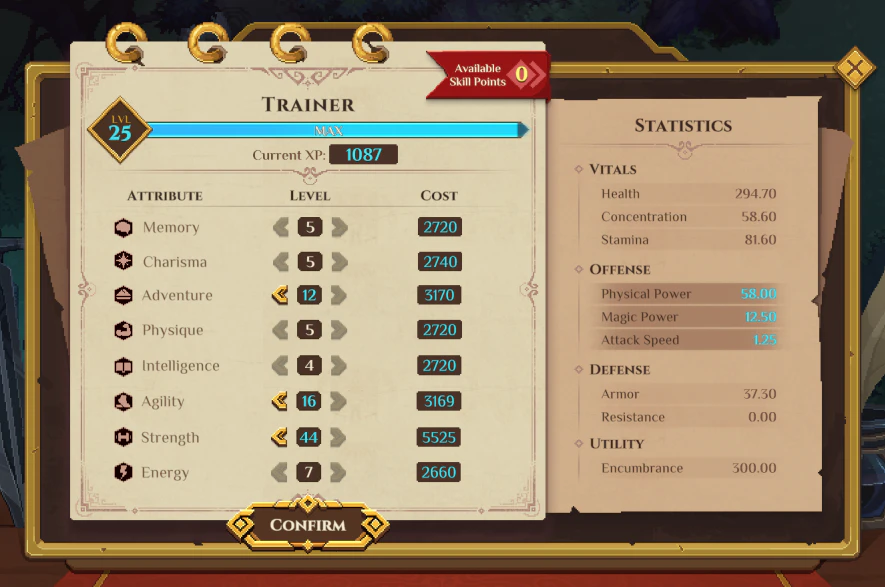
The game uses eight attributes in the following fixed order:
Mem, Cha, Adv, Phy, Int, Agi, Str, Ene
Physical and magic damage scale according to different combinations of attributes.
| Damage type | Combat Power formula |
|---|---|
| Physical | STR + 0.5 × (AGI + ADV) |
| Magic | INT + 0.5 × (CHA + ADV) |
Strength (STR) and Intelligence (INT) each contribute 1.0 Combat Power per point to their respective damage types. Agility (AGI), Advantage (ADV), and Charisma (CHA) normally contribute 0.5 per point.
Some racial and class passives modify these values, making certain secondary attributes more efficient for specific builds.
Passives that affect damage scaling
| Race and class | Passive effect | Effective attribute value |
|---|---|---|
| Human Magician | +0.25 Magic per ADV | ADV contributes 0.75 Magic |
| Human Brawler | +0.25 Physical per ADV | ADV contributes 0.75 Physical |
| Minotaur Magician | +0.5 Magic per STR | STR contributes 0.5 Magic |
| Elf Magician | +0.5 Magic per AGI | AGI contributes 1.0 Magic |
Human, Elf, and Minotaur Shadows, along with Elf and Minotaur Brawlers, have attack-speed or endurance passives that do not directly increase damage scaling.
Attribute Costs and Leveling
Upgrade cost formula
The base cost of an attribute is calculated by averaging the race’s and class’s base costs for that attribute:
base = 0.5 × (race base cost + class base cost)
The cost of purchasing the p-th point above an attribute’s starting value is:
cost = base × (1 + (p - 1) / 3)^1.1 + player level × 100
Each attribute has a cap of 99, and the maximum player level is 25.
Reaching level 25 requires approximately 122,400 XP, calculated as:
Σ round(100 × L^1.5 + 150) for L = 1 to 24
Spending XP increases player level, but attribute upgrades stop once level 25 is reached. Under this cost model, a character can realistically purchase approximately 44 to 54 additional attribute points.
Why balanced secondary investments matter
Although primary attributes provide twice the normal per-point Combat Power of secondary attributes, concentrating every available point in one attribute is not always optimal. Upgrade costs increase along a convex curve, making additional points progressively more expensive.
The most efficient approach is to invest heavily in the primary attribute for the chosen damage type, then distribute remaining points into the cheapest effective secondary attributes of that same damage type.
Advantage is particularly useful because it contributes to both physical and magic Combat Power. Investing in ADV does not automatically create a hybrid build: specialization is maintained by avoiding the opposing damage type’s primary attribute.
Optimal Attribute Builds for All Nine Archetypes
The following recommendations assume the character reaches level 25 and allocates points according to the upgrade-cost model.
The listed additions are points purchased above the character’s starting attributes. Combat Power includes the starting attributes and applicable passive bonuses.
Recommended point allocations
| Race and class | Physical damage allocation | Physical CP | Magic damage allocation | Magic CP |
|---|---|---|---|---|
| Human Magician | STR +34, ADV +8, AGI +2 | 48.5 | INT +34, ADV +16, CHA +1 | 62.5 |
| Human Brawler | STR +34, ADV +16, AGI +1 | 62.0 | INT +34, ADV +8, CHA +2 | 48.5 |
| Human Shadow | STR +35, ADV +6, AGI +5 | 53.5 | INT +35, ADV +7, CHA +6 | 53.5 |
| Elf Magician | STR +30, ADV +9, AGI +9 | 49.5 | INT +26, AGI +26, CHA +1, ADV +1 | 74.5 |
| Elf Brawler | STR +37, ADV +5, AGI +7 | 58.0 | INT +35, ADV +7, CHA +3 | 49.5 |
| Elf Shadow | STR +34, ADV +4, AGI +8 | 54.0 | INT +39, ADV +5, CHA +2 | 54.5 |
| Minotaur Magician | STR +37, ADV +6, AGI +2 | 52.5 | INT +38, ADV +4, CHA +3, STR +6 | 59.5 |
| Minotaur Brawler | STR +46, ADV +3 | 63.5 | INT +34, ADV +8, CHA +2 | 46.0 |
| Minotaur Shadow | STR +39, ADV +5, AGI +2 | 57.5 | INT +37, ADV +6, CHA +2 | 50.5 |
Final Attribute Spreads
The following tables show the complete attribute distributions after all recommended points have been allocated.
Attribute order is [Mem, Cha, Adv, Phy, Int, Agi, Str, Ene]. The recommended investments are emphasized in the allocation tables above.
Physical damage builds
| Race and class | Final attributes [Mem, Cha, Adv, Phy, Int, Agi, Str, Ene] |
|---|---|
| Human Magician | 7, 7, 14, 5, 8, 7, 38, 6 |
| Human Brawler | 5, 5, 22, 7, 4, 7, 42, 7 |
| Human Shadow | 6, 6, 12, 4, 6, 13, 41, 6 |
| Elf Magician | 7, 7, 15, 3, 8, 16, 34, 6 |
| Elf Brawler | 5, 5, 11, 5, 4, 15, 45, 7 |
| Elf Shadow | 6, 6, 10, 2, 6, 18, 40, 6 |
| Minotaur Magician | 6, 6, 12, 6, 6, 7, 43, 7 |
| Minotaur Brawler | 4, 4, 9, 8, 2, 6, 56, 8 |
| Minotaur Shadow | 5, 5, 11, 5, 4, 10, 47, 7 |
Magic damage builds
| Race and class | Final attributes [Mem, Cha, Adv, Phy, Int, Agi, Str, Ene] |
|---|---|
| Human Magician | 7, 8, 22, 5, 42, 5, 4, 6 |
| Human Brawler | 5, 7, 14, 7, 38, 6, 8, 7 |
| Human Shadow | 6, 12, 13, 4, 41, 8, 6, 6 |
| Elf Magician | 7, 8, 7, 3, 34, 33, 4, 6 |
| Elf Brawler | 5, 8, 13, 5, 39, 8, 8, 7 |
| Elf Shadow | 6, 8, 11, 2, 45, 10, 6, 6 |
| Minotaur Magician | 6, 9, 10, 6, 44, 5, 12, 7 |
| Minotaur Brawler | 4, 6, 14, 8, 36, 6, 10, 8 |
| Minotaur Shadow | 5, 7, 12, 5, 41, 8, 8, 7 |
Starting Attribute Distributions
Use these starting values to understand how each optimized build develops from its initial character setup.
| Race and class | Starting attributes [Mem, Cha, Adv, Phy, Int, Agi, Str, Ene] |
|---|---|
| Human Magician | 7, 7, 6, 5, 8, 5, 4, 6 |
| Human Brawler | 5, 5, 6, 7, 4, 6, 8, 7 |
| Human Shadow | 6, 6, 6, 4, 6, 8, 6, 6 |
| Elf Magician | 7, 7, 6, 3, 8, 7, 4, 6 |
| Elf Brawler | 5, 5, 6, 5, 4, 8, 8, 7 |
| Elf Shadow | 6, 6, 6, 2, 6, 10, 6, 6 |
| Minotaur Magician | 6, 6, 6, 6, 6, 5, 6, 7 |
| Minotaur Brawler | 4, 4, 6, 8, 2, 6, 10, 8 |
| Minotaur Shadow | 5, 5, 6, 5, 4, 8, 8, 7 |
Strict Single-Attribute Builds
Characters can instead concentrate all purchased points in a single attribute while remaining specialized in one damage type. However, this approach produces slightly less Combat Power in the tested combinations below.
| Race and class | Single-attribute investment | CP | Optimized CP |
|---|---|---|---|
| Elf Magician, Magic | All points in INT | 65.5 | 74.5 |
| Human Magician, Magic | All points in INT | 58.0 | 62.5 |
| Minotaur Brawler, Physical | All points in STR | 63.0 | 63.5 |
| Elf Brawler, Physical | All points in STR | 56.0 | 58.0 |
Why the Elf Magician should split INT and AGI
The Elf Magician benefits from a passive that grants +0.5 Magic per AGI, increasing AGI’s effective magic scaling to 1.0 per point. This makes AGI as valuable as INT for magic Combat Power.
A pure-INT build reaches 65.5 Magic Combat Power, compared with 74.5 for the optimized build. The recommended allocation invests 26 points in INT and 26 in AGI, with one additional point each in CHA and ADV.
For an Elf Magician focused on magic damage, keeping INT and AGI close to an even split is substantially more effective than investing exclusively in INT.
Key Optimization Principles
Physical damage
STR is the primary attribute for physical builds across all nine race and class combinations because it contributes 1.0 Physical Combat Power per point.
After investing in STR, use ADV and AGI as secondary attributes, accounting for their upgrade costs and any passive bonuses. Human Brawlers benefit especially from ADV, which contributes 0.75 Physical Combat Power per point because of their class passive.
The Minotaur Brawler is the strongest physical archetype under this model, reaching 63.5 Physical Combat Power. Its STR base cost is only 120, allowing particularly efficient investment in its primary attribute.
The Human Magician has the lowest optimized physical result, at 48.5 Physical Combat Power.
Magic damage
INT is the primary attribute for magic builds in every archetype except the Elf Magician, whose passive makes AGI equally valuable for magic scaling.
Human Magicians should invest heavily in ADV because their passive raises its magic contribution to 0.75 per point. Minotaur Magicians can also gain magic Combat Power from STR because their passive grants +0.5 Magic per STR point.
The Elf Magician is the strongest magic archetype, reaching 74.5 Magic Combat Power. The Minotaur Brawler has the lowest optimized magic result, at 46.0.
Base upgrade costs and attribute efficiency
Attribute base costs determine how efficiently a build can purchase additional points. Passive bonuses alone do not determine the optimal distribution.
Notable base-cost discounts include:
| Race or class | Attribute | Base cost |
|---|---|---|
| Elf | AGI | 120 |
| Elf | INT | 140 |
| Minotaur | STR | 120 |
| Magician | INT | 120 |
| Brawler | STR | 120 |
| Shadow | AGI | 120 |
ADV is useful for both physical and magic builds because it contributes 0.5 Combat Power to each damage type before applicable passive bonuses. Its relatively broad usefulness makes it a common secondary investment.
Nevertheless, polarized builds avoid investing in the opposing damage type’s primary attribute. Physical builds do not level INT, and magic builds do not level STR, except for the Minotaur Magician, whose passive explicitly converts STR investment into magic scaling.
Limitations of the Builds
These allocations optimize additive Combat Power under the assumed level-25 cap and attribute cost model. They exclude flat and percentage bonuses from runes, skill trees, and equipment.
The calculations assume points are purchased using the modeled cost curve and that the character reaches level 25 with approximately 122,400 XP.
Combat Power is not the same as damage per second. Archetypes with attack-speed, crit, or endurance advantages may trade some Combat Power for speed, evasion, or survivability. A build with the highest calculated Combat Power is therefore not necessarily the best choice for every combat situation.



Be the first to comment